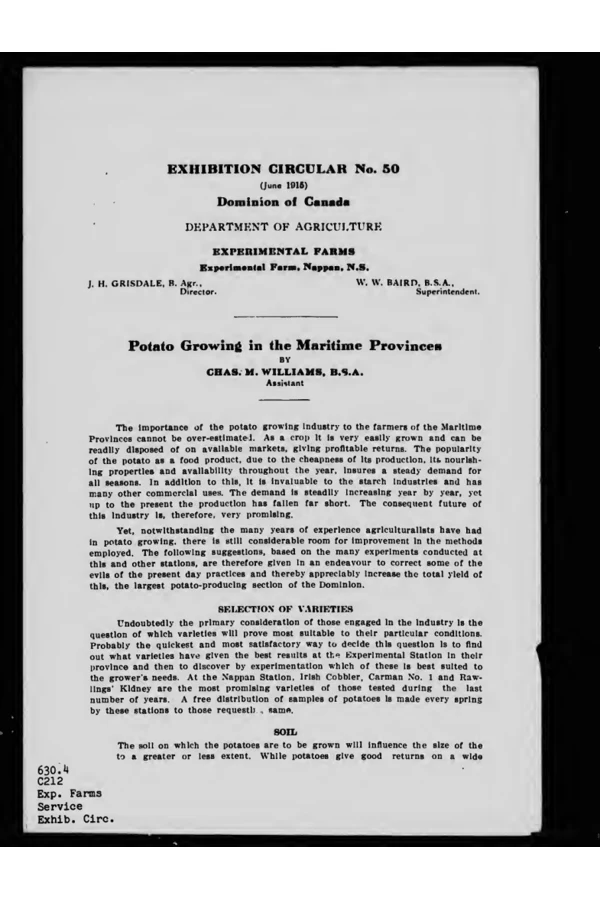
Sweet-Potato Growing in the Cotton Belt by H. C. Thompson is a concise guide issued by the United States Department of Agriculture’s Office of the Secretary on March 9, 1915. A note identifies its audience as cotton-belt farmers seeking to diversify during an economic crisis affecting cotton.
A food crop within diversified farming
The introduction presents sweet potatoes as food for the farm household, a product for nearby towns and more distant markets, a canning crop and a feed for livestock.
This gives the leaflet a clear purpose. It asks how a southern farm could make fuller use of a familiar crop, including keeping it available beyond the short autumn harvest period.
The market figures and expectations belong to the publication’s date. They provide context for the advice without establishing a present-day selling price or a guaranteed return.
Soil and rotations
Soils are discussed before the planting methods. Thompson emphasizes drainage and the character of the ground, while distinguishing vigorous vine growth from the production of a useful root crop.
The rotation section advises against returning sweet potatoes repeatedly to the same land. It gives three-year and four-year examples involving other crops and notes that these examples need adaptation to local conditions.
For a self-sufficiency reference collection, this connection is useful: the sweet-potato crop forms one stage in the continuing management of land, rather than a task considered only between planting and digging.
Slips, cuttings and plant beds
The propagation section distinguishes slips, also called draws, from vine cuttings. It relates the choice of material to the season and the purpose of the crop.
The production of slips is described through the preparation and management of plant beds. The text discusses timing, soil, bedding of roots, moisture, warmth and the appearance of young shoots.
These passages let readers follow how planting stock is produced before the field is ready. They also show why propagation work and the main crop occupy different places in the farm calendar.
Historical plant-bed and fertility recommendations should be interpreted in their original setting, with current practice considered separately before making changes on a farm.
Planting and cultivation
Preparation of soil, manure and fertilizers lead into setting plants. The leaflet describes both hand work and transplanting machinery and considers the condition of plants as they are moved.
Cultivation then follows the crop’s development. Early work between rows differs from later attention as the vines spread, and the text explains how the sequence changes as access to the soil becomes more limited.
The compact format makes these operations easy to read as a whole. It gives the reader an outline of the growing season without the extended experimental tables of a larger bulletin.
Harvest, storage and grading
Harvesting is connected with maturity, frost, injury and decay. Thompson emphasizes care in digging and handling, followed by separation of material suitable for keeping or other uses.
The storage discussion treats curing and later holding conditions as distinct stages. It links temperature and ventilation with the preservation of roots after harvest.
Grading and packages receive attention in relation to marketing. The account therefore carries the crop beyond yield alone to the state in which it can be kept and presented to a buyer.
Varieties and animal feed
The variety discussion connects the choice of a sort with household preference, market demand and intended use. It distinguishes moist-fleshed and mealy types rather than assuming that one kind answers every purpose.
A final section considers feeding sweet potatoes to livestock and using culls from the market crop. Its comparisons are historical feeding information, not a complete modern ration plan.
This free ebook suits readers studying southern farming, crop diversification and traditional sweet-potato husbandry. The PDF contains nine digital pages, including a preliminary blank page, with eight printed pages of text. The original type is small, so enlarge quantities and planting details and read the short sections in their full sequence.
Book details
- Author: H. C. Thompson
- Publisher: United States Department of Agriculture, Office of the Secretary; Government Printing Office, Washington
- Year: 1915
- Edition: Special publication; issued March 9, 1915
- Digital length: 9 PDF pages
- Language: English
- File size: 0.70 MB