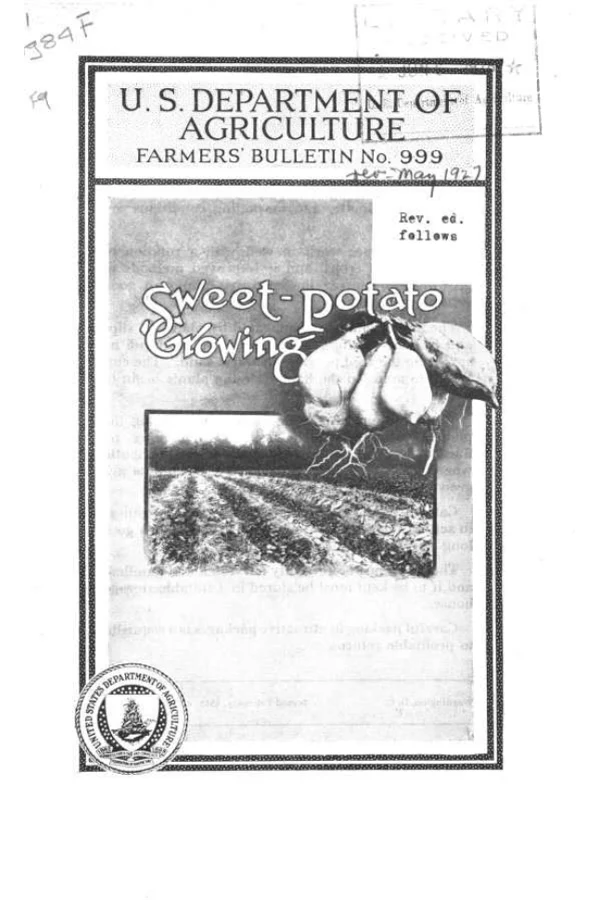
Sweet-Potato Diseases by L. L. Harter is an illustrated guide to troubles affecting sweet potatoes in the field, in storage and in transit. The United States Department of Agriculture issued it as Farmers’ Bulletin No. 1059 in October 1919, revising the earlier Farmers’ Bulletin 714.
Organizing the problem by plant and place
The bulletin begins by separating field diseases from storage rots. Within field diseases, it distinguishes troubles of roots and stems from those affecting leaves.
An opening classification lists characteristic symptoms and points readers toward the relevant pages. This gives the short publication a reference structure that can be followed without reading every disease account in order.
The arrangement is useful to readers studying agricultural diagnosis because it connects names with the parts of the plant being examined. Its scientific explanations and terminology remain those of the publication’s date.
Stem and root diseases
Stem-rot, black-rot, foot-rot, scurf and root-rot receive separate attention. Photographs show plants, cut roots and visible damage, supporting descriptions that would otherwise be difficult to picture.
The stem-rot discussion follows symptoms in the field and hotbed, then examines the movement of disease through planting stock and other routes. Seed selection, plant-bed preparation and rotation are considered together.
Black-rot is discussed in relation to both sprouts and roots. This reinforces a recurring point in the bulletin: problems visible at storage may be connected with what happened earlier in propagation and field growth.
For a historical reference collection, the combination of symptom descriptions and illustrated examples is the strongest part of these sections. Similar symptoms in a present crop still require current diagnosis.
Leaf diseases and comparisons
The foliage section covers leaf-blight, leaf-spot and white-rust. The author distinguishes the appearance of these conditions from the more extensive root and stem problems described earlier.
The text’s estimates of seriousness refer to the experience and information available in 1919. They should not be assumed to describe every modern growing region or season.
Reading the leaf accounts alongside the root sections shows how Harter grouped diseases according to where their effects could be seen and how they were thought to spread.
Rots after harvest
The storage discussion includes soft-rot, ring-rot, black-rot, dry-rot, Java black-rot and charcoal rot. It distinguishes watery breakdown from firmer forms of decay and connects symptoms with storage conditions.
Careful handling and the selection of sound roots appear alongside management of the storage house. The account links bruising, infected material and the environment in which harvested roots are kept.
This makes the bulletin relevant beyond a list of named diseases. It documents how an early plant pathologist connected the growing crop with losses during keeping and shipment.
The opening summary and detailed classification do not use precisely the same count of storage troubles. Readers should follow the individual named sections rather than relying only on the summary’s total.
Reading the control sections historically
Control discussions include sanitation, crop rotation, seed selection and treatment of planting material. Some chemical procedures use mercury compounds and formaldehyde solutions.
Those chemicals and procedures are historical information, not recommendations for a present-day garden, food crop or home storage space. Their value here lies in understanding the development of agricultural disease management.
The author also discusses limits to particular treatments, including the difficulty of reaching organisms within plant tissues. These explanations show the reasoning behind the recommendations as well as the recommendations themselves.
Audience and scan
This free ebook suits agricultural historians, readers studying sweet-potato production and researchers comparing early plant-disease literature. The illustrated symptoms, separate disease accounts and connection between field and storage give it a useful place beside general growing manuals.
The PDF contains 24 digital pages, including the cover and preliminary summary. It preserves photographs, small captions, handwritten cover markings and original pagination. Enlarge images and technical names, and interpret reported distribution, severity and treatments in their historical context.
Book details
- Author: L. L. Harter
- Publisher: United States Department of Agriculture, Washington, D.C.
- Year: 1919
- Edition: Farmers’ Bulletin No. 1059; October 1919; revision of Farmers’ Bulletin 714
- Digital length: 24 PDF pages
- Language: English
- File size: 1.00 MB