
Facts About Peat – Free PDF Download
In the early 1900s, long before modern renewable energy debates, inventors, engineers, and industrialists were searching for alternative fuel sources. One of the most fascinating forgotten fuels was peat.
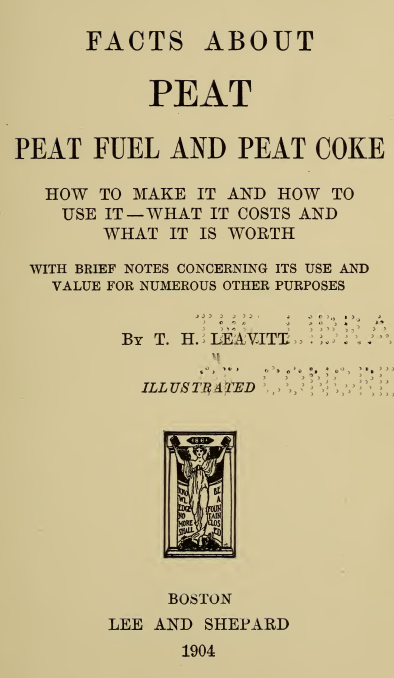
Facts About Peat: Peat Fuel and Peat Coke by T. H. Leavitt is a rare 1904 book that explores how peat was harvested, processed into fuel, and used for heating, steam generation, iron manufacturing, and even gunpowder production.
This historic guide gives a detailed look into an energy industry that many people today have never even heard of.
What Is Peat?
According to the book, peat is “decomposed vegetable matter” found in bogs and wetlands.
Peat forms over long periods of time as mosses, grasses, and aquatic plants slowly decay in waterlogged environments. The book describes peat as one of the transitional stages between vegetation and coal.
The author explains that different peat deposits varied greatly in quality:
- Some burned like soft pine
- Others compared to oak or hickory
- Dense peat could even be converted into peat coke for industrial use
Why Peat Fuel Was Important
In Europe, peat had already been used for centuries as a heating and industrial fuel. Countries including Scotland, Ireland, Germany, Sweden, Russia, Denmark, and Austria were already using peat fuel extensively by the early 1900s.
At the same time, the United States and Canada were beginning to explore peat as a possible large-scale energy source because of the enormous peat deposits found throughout North America.
What You’ll Learn Inside the Book
This free PDF covers much more than just burning peat in a fireplace.
Topics Included
- What peat is and where it forms
- How peat fuel was manufactured
- Peat briquetting and condensing methods
- Peat coke production
- Steam generation using peat fuel
- Peat in iron and steel manufacturing
- Gas production from peat
- Peat fertilizers and agricultural uses
- Peat as a disinfectant and deodorizer
- Industrial machinery used in peat processing
The original table of contents also includes sections on chemical products of peat, mixed fuels, and peat-moss litter.
Peat Fuel and Early Industrial Innovation
One of the most interesting parts of the book is its discussion of failed and successful attempts to industrialize peat fuel production.
The author details massive peat fuel projects in Canada, Germany, and the United States that attempted to compress peat into dense fuel briquettes using hydraulic presses and specialized machinery.
Some companies invested enormous amounts of money into the technology:
- Large hydraulic presses
- Drying cylinders
- Briquetting systems
- Condensing machinery
The book even describes a failed Hudson River peat company that reportedly spent hundreds of thousands of dollars attempting to commercialize peat fuel production.
For anyone interested in industrial history, forgotten energy technology, alternative fuels, or old engineering methods, this book is full of fascinating information.
Why Survivalists and Homesteaders May Find This Interesting
Modern off-grid communities often focus on:
- wood heat
- charcoal
- biomass fuel
- rocket stoves
- renewable heating
- Gas Alternative
This book shows that over 100 years ago, people were already experimenting with alternative fuel systems using natural wetland materials.
Even if you never plan to harvest peat yourself, the book offers insight into:
- fuel independence
- low-tech energy production
- resource utilization
- historical self-sufficiency methods
It’s a fascinating glimpse into how earlier generations approached energy shortages and fuel costs.
Final Thoughts
Facts About Peat is more than just an old fuel manual. It’s a snapshot of a time when engineers and inventors were searching for practical alternatives to coal and wood on an industrial scale.
Whether you’re interested in:
- survival history
- antique engineering
- homesteading
- prepper knowledge
- industrial archaeology
- renewable fuel experiments
this rare 1904 book is worth exploring.