
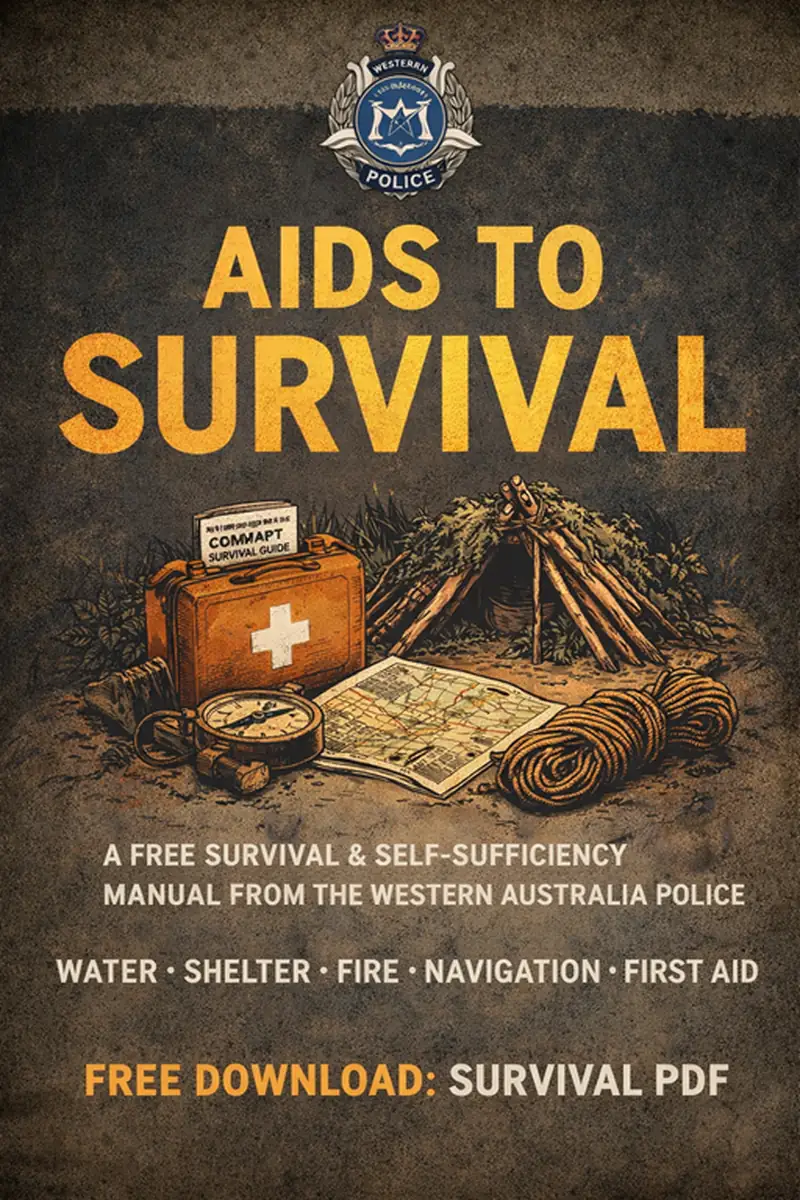
Aids to Survival: A Field-Tested Manual for Real Emergency Conditions
Police-developed survival guidance based on real-world incidents and remote-area operations
Aids to Survival is a practical survival and self-sufficiency manual developed by the Western Australia Police Academy for use in real emergency and remote-area conditions. First issued in 1979 and refined over more than two decades, the book reflects operational experience gained in harsh, isolated environments where poor decisions often lead to serious injury or loss of life.
Unlike modern survival publications that mix lifestyle content with hypothetical scenarios, this manual delivers direct, procedural instruction. It was written for situations where individuals may be lost, stranded, injured, or operating far from immediate assistance. Ardbark preserves this work as part of its educational reference archive to ensure experience-based survival knowledge remains accessible for learning and preparedness.
Why This Manual Was Written
The authors of Aids to Survival had a narrow and practical objective: helping people stay alive when normal support systems fail. The book does not assume ideal conditions, fast rescue, or unlimited resources. Instead, it focuses on what actually occurs during isolation, exposure, injury, or equipment failure.
A central theme throughout the manual is that panic and poor judgment cause more harm than environmental threats. Because of this, the book emphasizes:
Calm, deliberate decision-making
Structured thinking under pressure
Controlled use of energy and limited resources
Preparation is treated as the most powerful survival tool. As a result, many sections focus on mindset, prioritization, and planning before physical survival techniques are introduced.
Survival Treated as a Complete System
Rather than presenting disconnected tips, Aids to Survival approaches survival as a system of priorities. Each chapter reinforces the same foundational principles so that decisions made under stress remain consistent and logical.
The manual provides structured guidance on:
Locating, purifying, storing, and rationing water
Constructing shelter for heat, cold, wind, and exposure
Lighting fires using both standard tools and improvised methods
Managing stress, fear, and cognitive overload
Signaling for rescue and increasing visibility
Navigating without electronic devices
Responding to vehicle breakdowns in remote regions
Obtaining emergency food sources when necessary
Providing first aid when medical services are unavailable
These topics are presented through procedures, checklists, and concise explanations designed to remain usable under pressure.
Built on Real Incidents and Outcomes
Aids to Survival was written by law enforcement instructors and medical professionals responsible for training personnel operating in remote and high-risk environments. The guidance reflects documented rescue cases, field operations, and real incidents where outcomes were shaped by preparation and decision-making.
Over time, emergency services, outdoor organizations, and educational programs adopted the manual as required or recommended reading. Its continued use across decades reflects credibility rather than trend-following.
Because the book is grounded in outcomes instead of theory, it has retained relevance even as technology and equipment have changed.
Who This Manual Is Most Useful For
This manual is designed for readers who value function over hype. It is especially relevant for:
Individuals preparing for remote or off-grid living
Outdoor travelers operating far from populated areas
Households focused on emergency preparedness
Bushcraft and wilderness skills practitioners
Anyone building a reliable long-term reference library
Because the guidance focuses on principles rather than specific gear, it remains applicable across regions, climates, and generations.
Why the Guidance Still Holds Up
Many modern survival resources assume rapid rescue, advanced equipment, or stable infrastructure. Aids to Survival assumes none of those conditions. Instead, it prepares readers for uncertainty, isolation, and limited resources.
The manual avoids filler and speculation. Every section supports the same objective: extending survival time while improving the likelihood of rescue. As a result, readers gain knowledge that is practical, durable, and easier to retain under stress.
Its lasting value comes from teaching people how to think in emergency situations, not just what tools to carry.
Access Through the Ardbark Reference Archive
Ardbark preserves Aids to Survival as part of its educational archive of practical manuals and reference material. Providing access to historical and instructional works like this supports preparedness, education, and resilience beyond professional or institutional settings.
Readers researching emergency survival manuals or wilderness preparedness references will find this title especially informative.
A Manual Designed for When It Actually Matters
Aids to Survival delivers disciplined, experience-based instruction shaped by real outcomes. It does not rely on trends, marketing, or assumptions. Instead, it teaches readers how to plan, prioritize, and act when clear judgment and basic skills matter most.
For those serious about preparedness, resilience, and self-reliant living, this manual remains one of the most practical reference works available.