Bee-Keeping in Victoria is a substantial illustrated account of Australian apiary practice by F. R. Beuhne, the government apiculturist. Published as Bulletin No. 31 in the Department of Agriculture’s New Series, it brings together articles originally printed in the department’s journal.
The title page is undated; the volume is generally dated circa 1915. Its preface identifies the journal series as running from January 1912 to April 1915. Beuhne’s purpose was to explain methods tested under Australian conditions, with particular attention to commercial honey production.
Location, forage and the working colony
The opening chapters discuss where to establish an apiary and how the surrounding country affects its prospects. Beuhne distinguishes the importance of nectar-producing trees and other plants from the mere presence of abundant blossom.
He considers the relationship between locality, season and the scale of an operation. Site selection includes access, shelter, the arrangement of hives and the work required to manage them.
The bees themselves receive an introduction covering the queen, workers and drones, their development and the strains familiar to the author. This biological foundation leads into handling and equipment.
The regional emphasis is valuable for readers comparing Australian practice with European or North American manuals. The author repeatedly tests imported assumptions against a different climate and forage pattern.
Hives and the first season
Illustrations show hive construction and several frame patterns. The discussion explains floors, covers, spacing and other details that make a hive workable rather than simply providing housing for a colony.
Starting an apiary is considered through established colonies, swarms and nuclei. Beuhne describes the advantages and difficulties of each approach, including the need to judge the condition of stock before purchase.
A separate chapter addresses transferring bees from box hives into movable-frame equipment. Spring management then connects inspection, food, brood and the colony’s ability to expand.
Swarming receives sustained attention. Its causes and management are discussed in relation to the honey crop, the strength of colonies and the keeper’s ability to preserve a useful working population.
Harvesting and preparing honey
The honey chapters form a major practical section. They explain extraction, uncapping and the handling of honey after it leaves the comb, with photographs of operators and equipment.
Several extractor designs are illustrated. The author also considers the arrangement of an extracting plant and the ways in which the scale of an apiary changes the work.
Granulation and liquefying honey are treated as problems of product handling. These historical processing methods belong to the period; their value here is in showing how producers understood and managed the crop.
Comb honey has its own chapter, including sections, foundation and the relation between colony management and a marketable finished product. The book makes clear that extracted and comb honey impose different requirements.
Queens, feeding and colony health
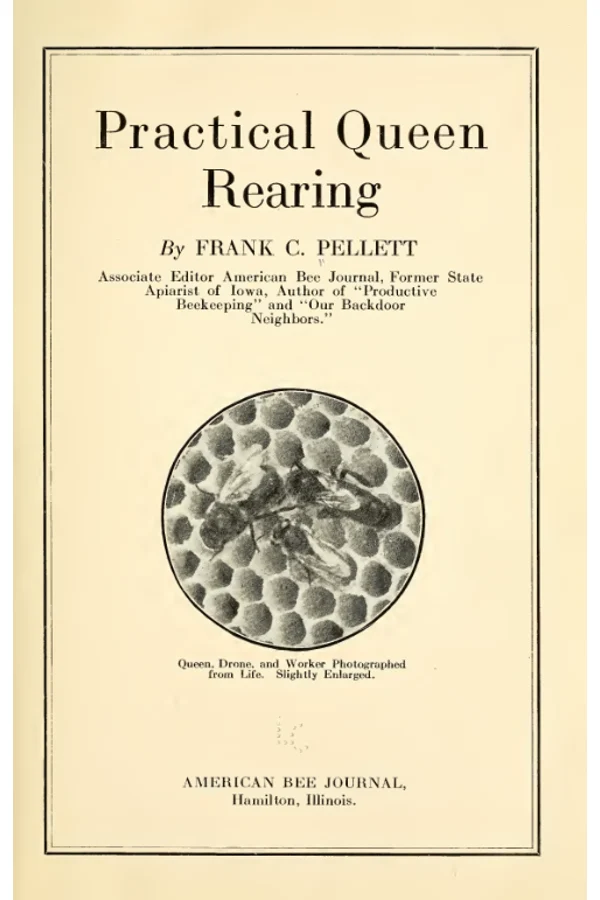
Queen rearing, nuclei and introducing queens are covered in consecutive chapters. Diagrams and photographs show queen cells, small colonies and cages used in the work.
Robbing, feeding and wintering follow. Beuhne distinguishes different purposes for feeding and discusses the local conditions that affect winter preparation.
The disease chapter describes brood and adult-bee problems as understood at the time. It includes photographs, microscopic illustrations and reports of contemporary investigations.
Disease theories, chemical remedies and pest-control suggestions in this historical text should not be used as current treatment instructions. The pages are useful evidence of the development of apiary health practice and the observations on which it rested.
Wax, foundation, water and pollination
The later chapters extend beyond the honey harvest. Beeswax recovery is described through presses, melting arrangements and separating equipment, with drawings showing their construction.
Comb foundation receives particularly detailed treatment, including plain wax sheets, dipping boards, rollers, trimming and fitting foundation into frames. Photographs make these workshop processes a distinctive part of the volume.
Water supply and the fertilization of flowers conclude the practical text. Orchard examples connect the apiary with fruit production and bring the discussion back to the surrounding farm.
This free ebook suits readers interested in Australian beekeeping history, traditional equipment and small agricultural industries. The PDF contains 136 digital pages, including library and blank material; the printed sequence reaches page 128 and includes an index. Enlarge the photographs and small equipment labels when studying individual operations.
Book details
- Author: F. R. Beuhne
- Publisher: Department of Agriculture, Victoria, Australia; Albert J. Mullett, Government Printer, Melbourne
- Year: Circa 1915 (undated title page)
- Edition: Bulletin No. 31, New Series; undated, circa 1915
- Digital length: 136 PDF pages
- Language: English
- File size: 7.52 MB