The Art of Masonry in Britain by William Diack follows the development of masonry as a building craft and a form of skilled work. Published in London at the Offices of The Stone Trades Journal in 1904, it combines a historical narrative with illustrations of buildings and craft traditions.
The craft behind the buildings
Diack states in his preface that his purpose is to describe the origin and development of the art and craft of masonry, especially during its earlier history. He distinguishes this approach from a history concerned chiefly with architectural styles and finished monuments.
His particular interest is the social life and work of British masons. Guild organization, the supervision of work and the people responsible for shaping and building with stone appear alongside castles, churches and other structures.
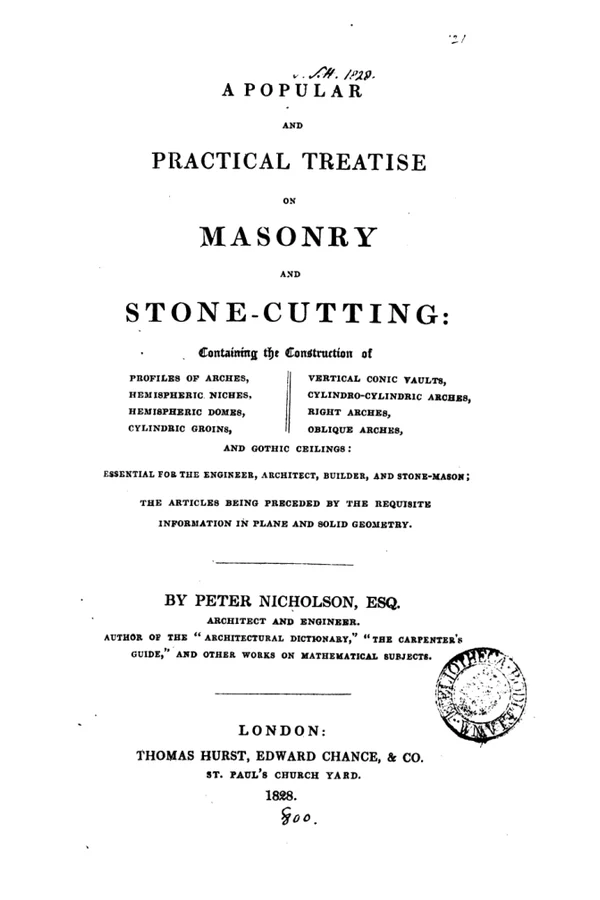
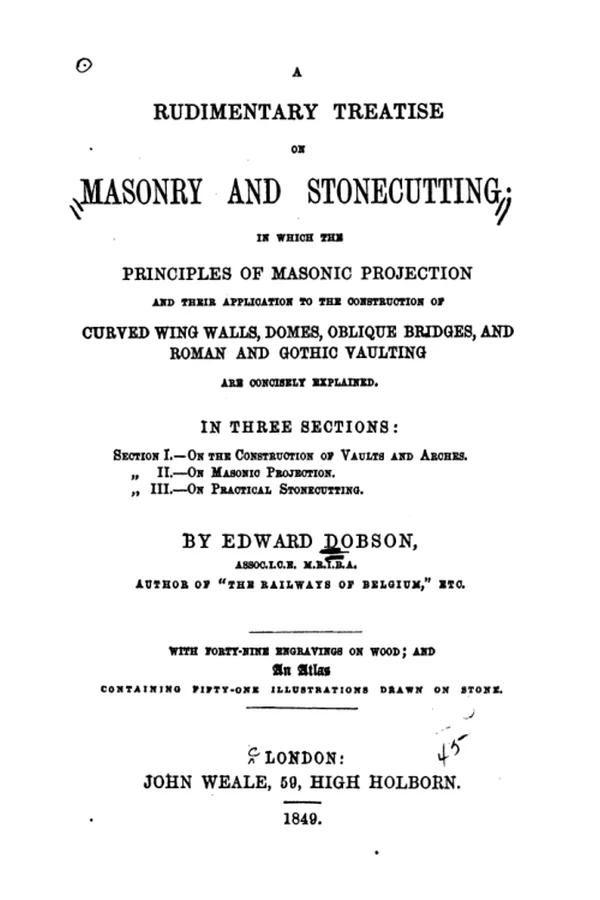
This makes the book a useful companion to technical stonecutting manuals. Where a geometrical treatise explains the form of a joint, Diack asks about the craft community and historical circumstances in which such work was carried out.
Early masonry and the Norman period
The opening chapter surveys the pre-Roman era, primitive British settlements, Roman building and early British masons. It introduces the long historical setting in which the later craft developed, using examples and accounts available to an author writing at the start of the twentieth century.
The next chapter treats the revival of masonry in Britain. Benedict Biscop and Wilfrid, early stone churches and King Alfred appear among its subjects. These pages link building activity with religious and political institutions.
The Norman era then brings castle building and the growth of organized craft traditions into view. The contents identify the masons’ guild and the role of masons in that period. Readers should approach the historical interpretations as Diack’s period account and consult later scholarship for current conclusions.
Castles, churches and regional examples
Several chapters are organized around old British masonry. Military examples include early castles, Warwick Castle and the development of English castles. These structures give the author a setting for discussing the work and circumstances of their builders.
Ecclesiastical masonry receives separate attention. Saxon churches, Norman masonry, the development of Gothic work and famous master masons all appear in the contents. The illustrations help connect the narrative with recognizable buildings and details.
A Scottish chapter includes early churches, the monastic cell, castles, the round tower tradition and notable Scottish churches. The geographical range is useful for readers who want to compare local craft histories rather than treating British masonry as a single uniform story.
Guilds, marks and working life
The chapter on the medieval masons’ guild discusses guild life, early records, labour conditions and the manuscript tradition. The Constitution of Masonry and the Four Crowned Martyrs form part of this treatment of craft identity and organization.
Another chapter considers masons’ marks and the working mason’s lodge. Aberdeen, Scottish masons, incorporated trades and differences in terminology appear in the discussion. Diack also includes the social life of the craft, including drinking customs.
These subjects are particularly relevant to craft historians. They show the author looking beyond the visible surface of a wall to the organization, signs and customs associated with its makers. They also explain why the book belongs beside practical building references in a historical library.
Renaissance builders and later developments
The later chapters move through the Renaissance, continental masons working in Scotland and prominent British architects. Brunelleschi, Inigo Jones, Christopher Wren and St. Paul’s Cathedral appear among the named subjects.
The closing material connects these developments with royal service and the work of earlier master masons. The narrative is selective rather than an exhaustive survey of every building or region, but its emphasis on the artisan remains a useful organizing thread.
Audience and digital copy
This free ebook is suited to readers of building history, traditional trades and British craft organization. It provides historical context rather than instructions for laying stone or designing a structure. Its language and interpretations reflect its publication date.
The PDF contains 123 digital pages, including preliminary matter and illustrations. It is an image-based scan with some sideways illustrations and blank pages. Browse visually and enlarge captions and small text when following the references to buildings or craftsmen.
Book details
- Author: William Diack
- Publisher: Offices of The Stone Trades Journal, London
- Year: 1904
- Edition: No numbered edition stated
- Digital length: 123 PDF pages
- Language: English
- File size: 6.96 MB