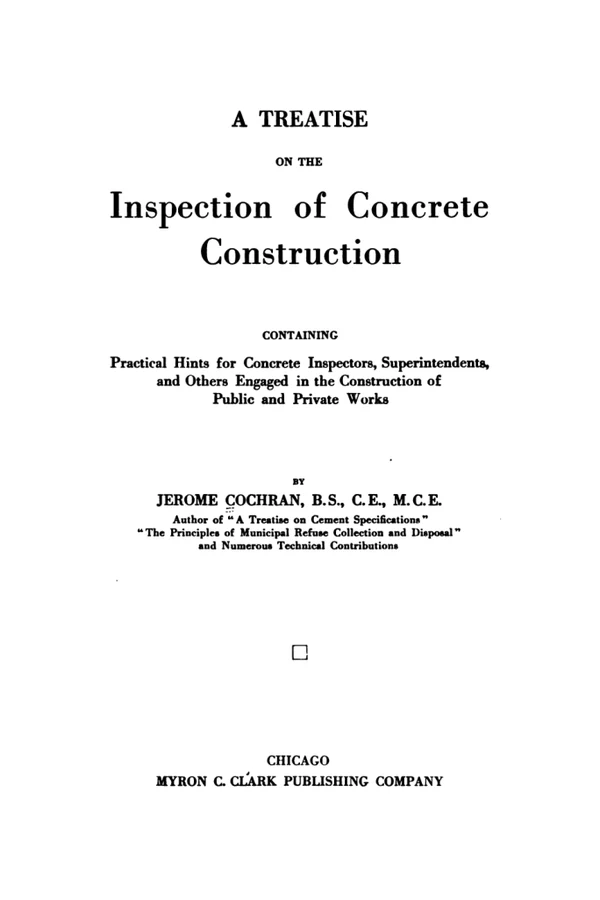
A Treatise on Cement Specifications by Jerome Cochran examines how cement was selected, purchased, inspected and tested in early twentieth-century construction. D. Van Nostrand Company published the book in New York in 1912. Its subtitle identifies Portland, natural, puzzolan or slag, and silica or sand cement, together with methods of testing and chemical analysis.
Specifications as a working document
Cochran describes his aim as a consistent, conveniently arranged set of specifications. He also recognizes that no single document can suit every construction project. The preface asks readers to consider surrounding conditions and limitations before applying the provisions.
That qualification helps explain the book’s organization. It separates the general conditions of use from purchasing, delivery, inspection and testing. Rather than treating a cement specification as a single strength requirement, the volume follows the material through several commercial and technical stages.
The introduction discusses the preparation of specifications and the selection of cement. It considers differences in the detail required by different engineering traditions and emphasizes clarity about what is required. Readers studying old contracts can use this discussion to understand the purpose behind clauses that might otherwise appear arbitrary.
Use, supply and purchase
The first part addresses general requirements, brand and composition, and silica or sand cement. A separate part concerns furnishing cement to the contractor, including unnecessary use and waste. These subjects place the technical material within the practical relationship between the supplier and the people performing the work.
Purchase tests and requirements are distinguished from acceptance tests. Cochran also includes a form of proposal for furnishing cement. This makes the book useful for research into construction administration as well as the history of materials testing.
For a self-sufficiency reference collection, the wider lesson is the importance of knowing what has been ordered, what has arrived and how its condition will be judged. The particular clauses and numerical limits remain historical and require comparison with current standards.
Delivery, storage and inspection
Delivery and storage receive their own part. Cement can be affected by the conditions in which it is kept, so the book follows purchasing with attention to handling before use. This sequence connects the paperwork of procurement to the physical condition of the material.
The inspection section covers sampling and the distinctions between field, laboratory and mill inspection. Acceptance requirements conclude that group. The arrangement shows that an inspection result depends partly on where, when and how a sample is obtained and examined.
These pages will interest readers tracing quality-control practices in historic building work. They also provide context for old laboratory reports and project records. They are a record of period procedures, rather than an instruction to reproduce every test with present-day materials.
Physical tests and their meaning
The test-requirement section considers the several cement classes separately, followed by additional and special requirements, quick-setting Portland cement and cement used in sea water. The methods section then treats fineness, specific gravity, normal consistency, setting time and briquette preparation.
Storage of test pieces, tensile strength, soundness and microscopical examination also appear. A later part addresses the significance of tests. By separating a procedure from its interpretation, Cochran gives readers more than a list of apparatus or pass-and-fail values.
The scanned pages preserve detailed instructions for making and handling test specimens. When researching a particular result, compare the exact procedure, specimen age and stated conditions. A historical tensile briquette result should not be treated as a modern structural-design value.
Chemical analysis and further reading
A separate part describes chemical analysis of Portland cement, including silica, alumina and iron, lime, magnesia, alkalies, sulphur compounds and loss on ignition. Bibliographies cover specifications and foreign specifications, offering a view of the technical literature available to the author.
This free ebook is suited to building historians, conservation researchers and students of construction materials. The PDF has 143 digital pages with searchable text. Its period terminology and specifications need historical interpretation, and precise values should be checked against the page image because text recognition can introduce errors.
Book details
- Author: Jerome Cochran
- Publisher: D. Van Nostrand Company, New York
- Year: 1912
- Edition: No numbered edition stated
- Digital length: 143 PDF pages
- Language: English
- File size: 9.25 MB